by Brandon Rhodes
• Home
GetPaid needs customizable forms
| Date: |
10 September 2009 |
|---|
| Tags: | computing, plone, python, zope |
|---|
I would like some advice from Zope and Plone folks
about how to create forms
that are not only easy for other developers to specialize,
but which allow several specializations to be composed together.
While I have used zope.formlib and z3c.form before
for simple tasks,
I have not yet been able to tell
whether they support these more advanced kinds of operations.
Some background:
I am doing some work
on GetPaid for Plone
with the generous funding of Derek Richardson who,
if his dreams had not carried him away from grad school
at the end of the Spring semester,
would have tackled this same work
as part of the 2009 Google Summer of Code.
The current mechanisms that GetPaid provides
for customizing its checkout process are very primitive,
and my task is to improve them.
That is why I have been thinking about customizing forms.
Plugging in payment processors
When a Plone user has filled their shopping cart with goods
and presses the “Checkout” button,
GetPaid begins stepping them through a checkout process
of several forms that must all be satisfied
before, finally, the user's credit card will be charged
and their purchase recorded.
GetPaid's current definition of a “Payment Processor”
requires only that it provide three functions
authorize(), capture(), and refund()
that talk on GetPaid's behalf to an online merchant account.
This design works fine
for traditional payment processors
that are comfortable letting Plone handle the credit card information,
but these days site owners usually want to delegate
the dangerous task of handling card numbers
to an “off-site” payment site.
And these off-site payment processors turn out to be
but one example
of the many ways in which GetPaid expansion modules
want to customize (or hijack?) the GetPaid checkout wizard.
Consider the following scenarios:
-
Something like Google Checkout
is comfortable taking the whole checkout process
out of your hands;
the “Checkout” button at the bottom of your shopping cart
is replaced with a branded “Google Checkout” button
that sends the user right to Google.
Currently in Getpaid, that button can only be customized
by providing completely new page templates for the shopping cart
that duplicate everything already there,
but which have a Google image on the checkout button.
-
Services like PxPay (at least the way we use them)
let the GetPaid checkout process
take care of collecting the customer's address
and shipping information,
but then need the user redirected off of the Plone site.
Again, entire views get replaced
just to provide an alternate submit button.
-
Many site owners want to allow several payment processors,
with the user choosing which one gets used
since the user might already have an account with Google Checkout
or be previously registered with PayPal.
This suggests the need for a “meta” payment processor
which can be given a list of payment processors and,
when the user reaches the first checkout step
for which those payment processors differ,
presents the user with a screen
from which they select the processor that they like.
-
Some sites have specialized information
that they need to collect from users:
they want to ask for extra address information,
or extra shipping options for certain products,
or need more contact information from the user
when they are checking out.
So, currently, in pretty much every one of the above situations,
the answer to, “How do I tweak the GetPaid checkout process?”
is, “Override the entire view or module
that you need to customize,
by providing your own copy
that looks exactly the same as the default one,
except for the one thing you need changed.”
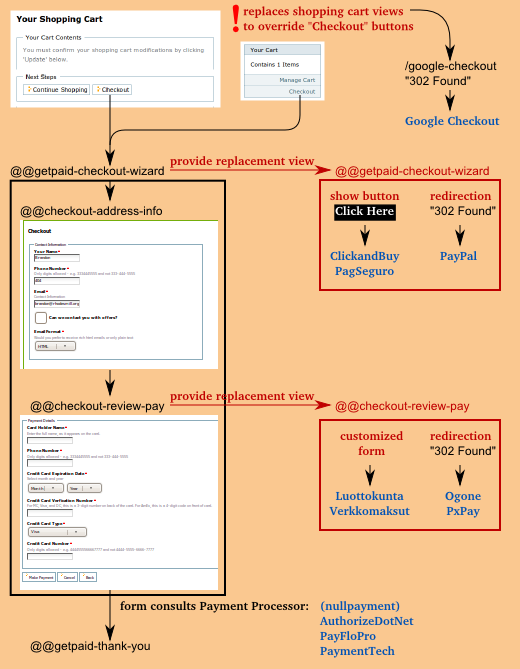
If you are curious, I have created
a diagram showing which payment processors
have to override which parts of GetPaid.
Not only does this wanton overriding
mean that modules have to meticulously track
the changes that GetPaid makes to the forms they are overriding,
but it means that customizations are inherently not composable:
you can't put two of them together.
The problem of composability is a big one.
Imagine that you live in Argentina
and want to install a module that adjusts GetPaid's mailing address form
to match the way postal addresses are formatted locally,
but that you also want to use an off-site payment processor
that needs to insert its custom “Checkout” button
on the bottom of the mailing address form.
Since the two modules will provide competing versions
of the entire mailing address form,
only one of them can “win”,
and the customization that the other module wants to present
will not be displayed.
Four crazy ideas
How might checkout process customizations
become operations that could be combined and composed,
instead of each one of them being a fragile, blanket replacement
of an entire part of GetPaid?
Here are four ideas that I have thought through
today as I sat with my trusty pencil and yellow pad:
-
Plug-in points.
Currently, GetPaid just has those three functions mentioned above
(authorize(), capture(), and refund())
where payment processors can plug into its checkout logic.
One way of solving the problems we are encountering
is simply to provide a lot more plug-in points
where GetPaid's default behavior can be adjusted or subverted.
It looks like this would have to include separate views
for every button, for the body of every major form,
and for the transitions between forms.
It is doable within the time I have left for this project,
and serves as my default, conservative option
if nothing more spectacular can happen right now.
But it's very brittle:
every time in the future that someone thinks of a new way
of adjusting or tweaking GetPaid,
they have to ask us to create a new plug-in point.
-
Request-level wrapper.
It might be possible
(I mention this technique only for the sake of completeness,
to spur our imaginations)
to implement an off-site change processor
as a wrapper around GetPaid
that interacted at the bare level of incoming HTTP requests
and outgoing HTML pages or redirections.
If you have chosen Google Checkout,
a special wrapper would be installed
that would rewrite the shopping cart “Checkout” button with its own.
If you need another field added to the final checkout page,
you would create a wrapper that adds the field
when it sees the HTML for that form going out,
and that intercepts the additional field on its way back in.
Such wrappers would at least be composable:
you could have several active at once,
that each made their own modification to a single page
so that the user could see an address form
that was formatted for Argentina
and that had the correct checkout button on the bottom.
-
Wrap a form that provided an API.
What do forms “look like” to the code that calls them?
If we imagine a form library
where a Form is separate
from the FormRenderer
that introspects and traverses the properties of each form
to turn it into HTML,
then each GetPaid extension
could be a wrapper around the GetPaid form object(s)
that passes through most requests intact,
leaving most parts of most forms alone,
but that intercepts certain requests
and returns different answers than GetPaid would return.
The Argentina module would wrap the default GetPaid shipping form
and, when traversed for its sub-forms and fields,
would return a series of fields specific to Argentina.
The off-site payment processor wrapper
would just adjust the properties of the checkout button
before returning them.
And, these two wrappers would be composable!
If you wrapped them,
in any order,
around the default GetPaid checkout forms,
then you could enjoy both customizations.
-
Forms as modifiable objects.
What if forms — or even a small collection of forms,
like the GetPaid checkout process — were objects
that you could adjust and edit and modify
before asking them to be rendered?
Then, each GetPaid customization could be written
as a small routine that takes, as its argument,
a description of the entire checkout process,
and that modifies that description by tweaking, adding,
and removing everything that it needs to.
Before rendering a view for the user,
GetPaid would construct a copy of the checkout process,
and then pass it, in turn, to each module.
The Argentina module would reach in and tweak some address fields.
The off-site processor would reach in and adjust the checkout
button sitting below them.
And the result could then be rendered.
The one problem, when we compare this approach
to the previous scenario,
would be how to intercept new data that would be coming in
as a result of added form fields.
I suppose the form descriptions
would have to include callback functions
for processing them,
and that extension modules would just add their own callbacks.
Is there anything here worth trying?
These are just the ideas that have come to me today,
as I've scribbled and sketched
and sat down to re-read all of the design patterns
in the Gang of Four Book looking for inspiration.
(You might recognize the third option above
as something like the “decorator” design pattern!)
Does zope.formlib or z3c.form
or anything else like that in the Zope universe
provide the kind of services I would need from a form library
to implement the ideas outlined above?
looking for inspiration.
(You might recognize the third option above
as something like the “decorator” design pattern!)
Does zope.formlib or z3c.form
or anything else like that in the Zope universe
provide the kind of services I would need from a form library
to implement the ideas outlined above?
If you're a Zope or Plone person with an inkling of an answer,
then please let me know!
©2021